
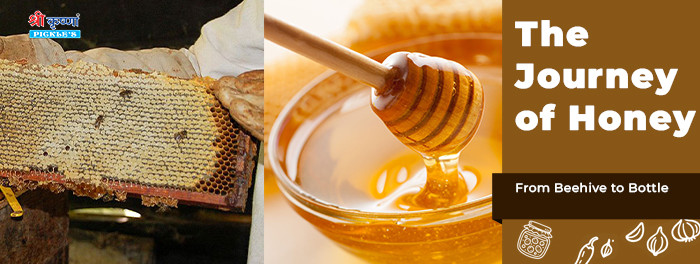
Honey is one of nature’s most remarkable gifts—pure, golden, and naturally sweet. But before it reaches your kitchen shelf, honey goes through a fascinating journey that begins inside a buzzing beehive and ends in a carefully sealed bottle. Understanding this journey not only deepens our appreciation for honey but also highlights the care, skill, and sustainability behind its production.
The Beginning: Flowers and Nectar
The journey of honey starts in blooming fields, forests, and orchards. Worker bees visit flowers to collect nectar, a sugary liquid produced by plants. Using their long tongues, bees store this nectar in a special stomach called the honey sac, separate from their digestive system.
As bees move from flower to flower, they also play a vital role in pollination, helping plants grow and reproduce. This makes honey production deeply connected to ecological balance.
Inside the Beehive: Nature’s Alchemy
Once the bees return to the hive, the real transformation begins. The nectar is passed from one bee to another through a process known as regurgitation. During this exchange, natural enzymes break down complex sugars into simpler ones.
The bees then store the nectar in hexagonal wax cells. To reduce moisture content, they fan their wings continuously, allowing water to evaporate. As the nectar thickens and matures, it becomes honey. Once ready, the cells are sealed with a thin layer of beeswax to preserve freshness.
Beekeepers and Ethical Harvesting
Beekeepers play a crucial role in bringing honey from hive to home. Ethical beekeeping practices ensure that bees are not harmed and that they retain enough honey for their own survival, especially during colder months.
When it’s time for harvesting:
-
Honeycomb frames are carefully removed
-
Bees are gently brushed away without damage
-
Wax caps are opened to access the honey
This respectful approach maintains hive health and long-term sustainability.
Extraction: Preserving Natural Goodness
The harvested frames are taken to extraction units where honey is removed without altering its natural properties. Typically, a centrifugal extractor spins the frames, allowing honey to flow out naturally.
After extraction:
-
Honey is strained to remove wax particles
-
No chemicals or additives are introduced
-
Minimal heating may be used to maintain texture
This step ensures the honey remains pure and rich in nutrients.
Bottling: Sealing Nature’s Sweetness
Once filtered, the honey is allowed to settle before being poured into clean, airtight bottles. Proper bottling helps preserve flavor, aroma, and nutritional value.
Depending on floral sources, honey may vary in color, thickness, and taste—each bottle telling a unique story of its origin.
From Nature to Your Table
By the time honey reaches your table, it has traveled through flowers, bees, beekeepers, and careful processing. Every drop represents teamwork between nature and humans, patience, and centuries-old traditions.
Choosing responsibly sourced honey supports ethical beekeeping, biodiversity, and sustainable agriculture.
Final Thoughts
The journey of honey from beehive to bottle is a beautiful example of how nature works in harmony. What begins as simple flower nectar becomes a nourishing food, crafted by bees and preserved by human care. The next time you enjoy a spoonful of honey, you’ll know it’s more than a sweet treat—it’s a story of nature’s finest craftsmanship.
Leave a Comment