
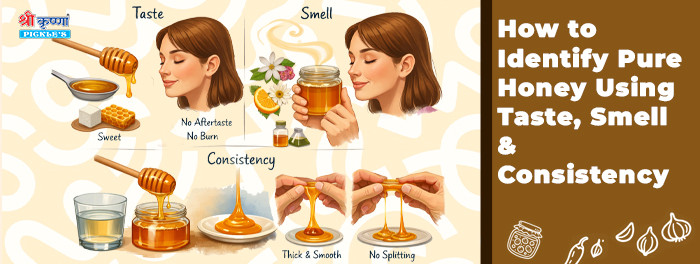
Honey has been valued for centuries not only as a natural sweetener but also for its health-boosting properties. However, with the growing demand for honey, the market is flooded with adulterated or artificial varieties. While lab tests can confirm purity, you can often identify pure honey at home using your senses—taste, smell, and consistency. Let’s explore how these simple checks can help you choose genuine honey.
1. Taste: Subtle, Not Overpowering
Pure honey has a balanced and layered flavor. It is sweet, but not sharply sugary like syrup or sugar water.
What to look for:
-
Natural honey often has mild floral, woody, or herbal notes depending on the nectar source.
-
The sweetness fades gradually after tasting, leaving a gentle aftertaste.
-
It may cause a slight tingling or warming sensation in the throat.
Signs of adulteration:
-
An overly sweet, flat taste with no depth.
-
A strong sugar-like or caramel flavor that lingers unnaturally.
-
No aftertaste or character beyond sweetness.
2. Smell: Earthy and Natural
Smell is a powerful indicator of honey’s authenticity. Pure honey carries the aroma of nature.
What to look for:
-
A mild, pleasant fragrance reminiscent of flowers, beeswax, or herbs.
-
The aroma is subtle, not overpowering.
-
Each variety of honey has a unique scent profile based on its origin.
Signs of adulteration:
-
No smell at all, which often indicates heavy processing.
-
Artificial or burnt sugar odors.
-
A sharp or chemical-like fragrance.
3. Consistency: Thick, Slow & Natural
The texture of honey reveals a lot about its purity. Genuine honey behaves differently from diluted or fake versions.
What to look for:
-
Pure honey is thick and flows slowly when poured.
-
When drizzled on a spoon, it forms a steady stream rather than breaking into droplets.
-
It tends to settle at the bottom of water instead of dissolving instantly.
Signs of adulteration:
-
Very runny or watery texture.
-
Breaks easily when poured.
-
Dissolves immediately in water, indicating added sugars or syrups.
4. Crystallization Is a Good Sign
Many people mistake crystallized honey for spoiled honey, but it’s actually a sign of purity.
What to know:
-
Natural honey crystallizes over time due to its glucose content.
-
The process depends on temperature and floral source.
-
Crystallized honey is still safe and nutritious.
Artificial honey often remains liquid for long periods because of additives and processing.
5. Trust Your Senses Before the Label
While packaging and labels can be misleading, your senses rarely are. Taste, smell, and consistency together offer strong clues about honey’s authenticity. When honey feels alive, aromatic, and naturally thick, it’s usually the real deal.
Final Thoughts
Identifying pure honey doesn’t always require scientific tools—your senses can do most of the work. By paying attention to how honey tastes, smells, and flows, you can confidently choose a natural product that delivers both flavor and health benefits. In a world of processed foods, trusting nature is often the safest choice.
Leave a Comment