
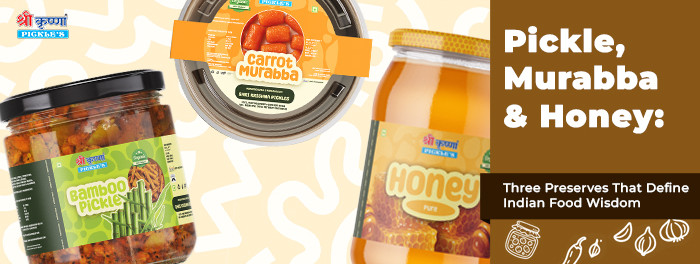
Indian food wisdom has always gone beyond taste. For centuries, preservation techniques were designed not just to extend shelf life, but to enhance nutrition, balance flavors, and support well-being. Among the many traditional methods, three preserves stand out for their enduring relevance—pickle, murabba, and honey. Each represents a unique approach to food preservation, deeply rooted in India’s culinary and cultural heritage.
Pickle: The Power of Fermentation and Spice
Pickles are one of India’s most iconic food traditions. Prepared using fruits or vegetables, salt, spices, oil, and time, pickles transform simple ingredients into bold, long-lasting accompaniments. The slow process of curing allows flavors to mature and deepen, while traditional spices help preserve the food naturally.
Beyond taste, pickles were traditionally consumed in small amounts to stimulate appetite and support digestion. Their sharp, spicy notes were believed to awaken the senses and balance heavy meals, making them a thoughtful addition rather than a side dish.
Murabba: Sweet Preservation With Nourishment
Murabba represents the sweeter side of Indian food preservation. Made by gently cooking fruits in sugar syrup, murabba retains the fruit’s essence while extending its usability across seasons. Unlike desserts, murabba was traditionally consumed in moderation as part of daily routines.
Elders valued murabba for its comforting nature, easy digestibility, and seasonal support. Varieties like amla murabba became household staples, appreciated not just for flavor but for their nourishing qualities. Murabba reflects India’s belief that sweetness, when used mindfully, can be both enjoyable and beneficial.
Honey: Nature’s Eternal Preserver
Honey is perhaps the most ancient and untouched of all preserves. Used for thousands of years, honey requires no processing to remain shelf-stable. Its natural composition allows it to last indefinitely while retaining its taste and properties.
In Indian food wisdom, honey was more than a sweetener—it was a carrier of nutrients and a natural preservative. It played a vital role in traditional formulations, where it enhanced flavor while supporting balance and absorption.
Three Preserves, One Philosophy
Though different in taste and preparation, pickle, murabba, and honey share a common philosophy. They rely on natural processes—fermentation, slow cooking, and inherent stability—rather than artificial methods. Each encourages moderation, patience, and respect for ingredients.
These preserves also highlight India’s deep understanding of seasonality. Pickles captured peak produce, murabba preserved fruits for year-round nourishment, and honey offered a timeless source of natural sweetness.
Relevance in Modern Kitchens
Even in today’s fast-paced world, these traditional preserves remain relevant. They add depth to meals, reduce dependence on artificial additives, and reconnect us with mindful eating practices. Their continued presence in Indian kitchens proves that traditional wisdom still holds value in modern lifestyles.
Final Thoughts
Pickle, murabba, and honey are more than preserved foods—they are symbols of Indian food wisdom. Each jar carries lessons of balance, patience, and nourishment passed down through generations. By embracing these timeless preserves, we honor a culinary legacy that teaches us how food can be both flavorful and thoughtful.
214 Comment(s)
I'm curious to find out what blog system you have been using? I'm experiencing some small security problems with my latest website and I'd like to find something more safeguarded. Do you have any recommendations?
When I initially commented I clicked the "Notify me when new comments are added" checkbox and now each time a comment is added I get three emails with the same comment. Is there any way you can remove people from that service? Appreciate it!
My brother recommended I might like this web site. He was entirely right. This post actually made my day. You can not imagine just how much time I had spent for this information! Thanks!
Hi there, its nice article regarding media print, we all be familiar with media is a impressive source of facts.
I believe what you wrote was very logical. But, consider this, suppose you were to write a killer headline? I ain't suggesting your information is not good, however what if you added something that grabbed a person's attention? I mean Pickle, Murabba & Honey: Three Preserves That Define Indian Food Wisdom is kinda boring. You could peek at Yahoo's home page and watch how they create news titles to get viewers to open the links. You might add a video or a related picture or two to grab people interested about what you've got to say. In my opinion, it could bring your website a little bit more interesting.
What's up i am kavin, its my first time to commenting anywhere, when i read this post i thought i could also create comment due to this sensible post.
Good post. I learn something new and challenging on sites I stumbleupon on a daily basis. It's always helpful to read through content from other authors and practice a little something from their web sites.
Howdy this is kind of of off topic but I was wanting to know if blogs use WYSIWYG editors or if you have to manually code with HTML. I'm starting a blog soon but have no coding skills so I wanted to get advice from someone with experience. Any help would be enormously appreciated!
There's definately a great deal to learn about this topic. I really like all of the points you made.
I visited many websites except the audio feature for audio songs current at this site is actually fabulous.
Really when someone doesn't understand afterward its up to other viewers that they will help, so here it happens.
Nice blog! Is your theme custom made or did you download it from somewhere? A theme like yours with a few simple adjustements would really make my blog shine. Please let me know where you got your design. Cheers
I would like to thank you for the efforts you've put in penning this site. I'm hoping to view the same high-grade blog posts from you in the future as well. In truth, your creative writing abilities has motivated me to get my own, personal website now ;)
Hey just wanted to give you a quick heads up. The text in your post seem to be running off the screen in Ie. I'm not sure if this is a formatting issue or something to do with internet browser compatibility but I figured I'd post to let you know. The layout look great though! Hope you get the issue resolved soon. Kudos
Starting with an online casino sign up offer adds extra value to the early experience. With additional balance support, users can try different styles of play in a comfortable way. A lot of users enjoy clear bonus terms. Combined with intuitive navigation, everything feels smooth and comfortable to use.
Getting started with a casino welcome offer can create a more enjoyable beginning for players. By receiving bonus value at the start, users can discover more game options. Modern audiences often like clear promotional terms. When paired with intuitive navigation, everything feels comfortable and pleasant to use.
My family members every time say that I am killing my time here at net, except I know I am getting experience daily by reading such nice posts.
I think the admin of this web site is actually working hard in support of his web page, because here every stuff is quality based information.
Why viewers still use to read news papers when in this technological globe all is available on net?
Very rapidly this website will be famous among all blog viewers, due to it's fastidious posts
Leave a Comment