
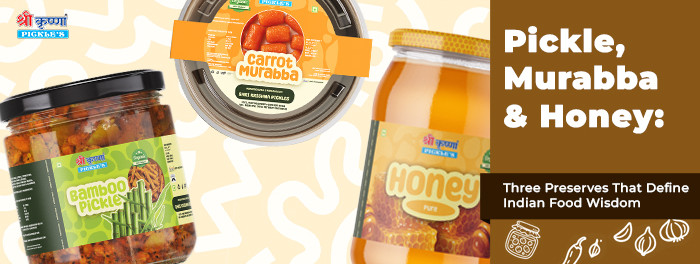
Indian food wisdom has always gone beyond taste. For centuries, preservation techniques were designed not just to extend shelf life, but to enhance nutrition, balance flavors, and support well-being. Among the many traditional methods, three preserves stand out for their enduring relevance—pickle, murabba, and honey. Each represents a unique approach to food preservation, deeply rooted in India’s culinary and cultural heritage.
Pickle: The Power of Fermentation and Spice
Pickles are one of India’s most iconic food traditions. Prepared using fruits or vegetables, salt, spices, oil, and time, pickles transform simple ingredients into bold, long-lasting accompaniments. The slow process of curing allows flavors to mature and deepen, while traditional spices help preserve the food naturally.
Beyond taste, pickles were traditionally consumed in small amounts to stimulate appetite and support digestion. Their sharp, spicy notes were believed to awaken the senses and balance heavy meals, making them a thoughtful addition rather than a side dish.
Murabba: Sweet Preservation With Nourishment
Murabba represents the sweeter side of Indian food preservation. Made by gently cooking fruits in sugar syrup, murabba retains the fruit’s essence while extending its usability across seasons. Unlike desserts, murabba was traditionally consumed in moderation as part of daily routines.
Elders valued murabba for its comforting nature, easy digestibility, and seasonal support. Varieties like amla murabba became household staples, appreciated not just for flavor but for their nourishing qualities. Murabba reflects India’s belief that sweetness, when used mindfully, can be both enjoyable and beneficial.
Honey: Nature’s Eternal Preserver
Honey is perhaps the most ancient and untouched of all preserves. Used for thousands of years, honey requires no processing to remain shelf-stable. Its natural composition allows it to last indefinitely while retaining its taste and properties.
In Indian food wisdom, honey was more than a sweetener—it was a carrier of nutrients and a natural preservative. It played a vital role in traditional formulations, where it enhanced flavor while supporting balance and absorption.
Three Preserves, One Philosophy
Though different in taste and preparation, pickle, murabba, and honey share a common philosophy. They rely on natural processes—fermentation, slow cooking, and inherent stability—rather than artificial methods. Each encourages moderation, patience, and respect for ingredients.
These preserves also highlight India’s deep understanding of seasonality. Pickles captured peak produce, murabba preserved fruits for year-round nourishment, and honey offered a timeless source of natural sweetness.
Relevance in Modern Kitchens
Even in today’s fast-paced world, these traditional preserves remain relevant. They add depth to meals, reduce dependence on artificial additives, and reconnect us with mindful eating practices. Their continued presence in Indian kitchens proves that traditional wisdom still holds value in modern lifestyles.
Final Thoughts
Pickle, murabba, and honey are more than preserved foods—they are symbols of Indian food wisdom. Each jar carries lessons of balance, patience, and nourishment passed down through generations. By embracing these timeless preserves, we honor a culinary legacy that teaches us how food can be both flavorful and thoughtful.
214 Comment(s)
I'm truly enjoying the design and layout of your site. It's a very easy on the eyes which makes it much more pleasant for me to come here and visit more often. Did you hire out a designer to create your theme? Outstanding work!
I have read several just right stuff here. Definitely value bookmarking for revisiting. I wonder how so much attempt you set to make any such magnificent informative website.
It's remarkable to go to see this site and reading the views of all friends concerning this article, while I am also keen of getting know-how.
Hello there, just became aware of your blog through Google, and found that it's truly informative. I am gonna watch out for brussels. I will be grateful if you continue this in future. Numerous people will be benefited from your writing. Cheers!
I loved as much as you'll receive carried out right here. The sketch is tasteful, your authored subject matter stylish. nonetheless, you command get got an edginess over that you wish be delivering the following. unwell unquestionably come further formerly again since exactly the same nearly very often inside case you shield this increase.
Thank you for sharing your thoughts. I really appreciate your efforts and I will be waiting for your further post thanks once again.
I hardly comment, but I read a lot of comments here Pickle, Murabba & Honey: Three Preserves That Define Indian Food Wisdom. I do have 2 questions for you if it's okay. Is it simply me or do some of the responses look like they are written by brain dead individuals? :-P And, if you are writing at other sites, I would like to follow you. Could you list of all of your social networking pages like your linkedin profile, Facebook page or twitter feed?
Howdy, i read your blog occasionally and i own a similar one and i was just wondering if you get a lot of spam comments? If so how do you prevent it, any plugin or anything you can advise? I get so much lately it's driving me insane so any support is very much appreciated.
Howdy I am so happy I found your website, I really found you by accident, while I was researching on Google for something else, Anyhow I am here now and would just like to say thanks for a tremendous post and a all round enjoyable blog (I also love the theme/design), I don’t have time to read it all at the moment but I have bookmarked it and also added your RSS feeds, so when I have time I will be back to read a great deal more, Please do keep up the excellent b.
Outstanding quest there. What happened after? Take care!
constantly i used to read smaller content which also clear their motive, and that is also happening with this article which I am reading at this time.
Great delivery. Solid arguments. Keep up the great effort.
This is very interesting, You're an excessively professional blogger. I've joined your rss feed and look ahead to searching for more of your wonderful post. Also, I have shared your website in my social networks
Does your site have a contact page? I'm having a tough time locating it but, I'd like to shoot you an email. I've got some creative ideas for your blog you might be interested in hearing. Either way, great website and I look forward to seeing it develop over time.
What's up friends, its great post about cultureand completely explained, keep it up all the time.
Thanks very nice blog!
That is really interesting, You're a very skilled blogger. I have joined your rss feed and sit up for seeking more of your great post. Also, I have shared your website in my social networks
great post, very informative. I wonder why the opposite specialists of this sector don't understand this. You must continue your writing. I am confident, you have a great readers' base already!
Your mode of describing the whole thing in this article is actually nice, all be able to effortlessly know it, Thanks a lot.
Truly when someone doesn't know then its up to other people that they will assist, so here it takes place.
Leave a Comment